A well-designed home theater depends on more than a large screen, powerful speakers, and comfortable seating. The room itself has a major influence on how the audio system performs. Sound waves reflect from walls, ceilings, floors, windows, and other hard surfaces, creating unwanted echoes and reverberation that can reduce dialogue clarity and affect the overall listening experience.
This is why acoustic treatment should be considered an important part of home theater design. Home theater acoustic panels can help absorb unwanted sound reflections, improve speech intelligibility, and create a more controlled acoustic environment.
However, choosing the right panels is not simply a matter of selecting the thickest or most attractive product. Material, thickness, acoustic performance, panel placement, room size, installation method, appearance, and budget all need to be considered together.
This home theater acoustic panels buying guide explains the main factors homeowners, interior designers, contractors, and acoustic product buyers should evaluate before purchasing panels for a dedicated cinema room or multipurpose media space.
Why Do Home Theaters Need Acoustic Panels?
When a speaker produces sound, some sound travels directly toward the listener while other sound energy reaches nearby surfaces and reflects back into the room.
In a room with many hard surfaces, these reflections can overlap with direct sound. When this happens repeatedly, the result may be excessive reverberation, reduced clarity, and a less precise soundstage.
Common acoustic problems in home theaters include:
Excessive echo
Long reverberation
Unclear dialogue
Poor sound imaging
Excessive high-frequency reflections
Distracting background reflections
Uneven listening conditions
Home theater acoustic panels work by absorbing a portion of the sound energy that would otherwise reflect from walls and ceilings.
This can help make voices easier to understand and allow music and movie sound effects to sound more controlled.
It is important to distinguish acoustic treatment from soundproofing. Acoustic panels primarily improve the sound inside the room. They do not automatically prevent sound from passing through walls, doors, floors, or ceilings.
If the objective is to keep movie sound from disturbing adjacent rooms, additional construction measures may be necessary, such as wall isolation, additional mass, acoustic seals, or decoupled structures.
1. Start by Understanding Your Home Theater Room
Before comparing acoustic panels, take time to evaluate the room itself.
A small media room with carpet and upholstered furniture will have different acoustic requirements from a large dedicated home cinema with concrete walls and a hard floor.
Start by recording the basic room information:
Length
Width
Ceiling height
Wall construction
Flooring material
Ceiling material
Window locations
Door locations
Speaker positions
Seating positions
Also consider how the room will be used.
A dedicated cinema may have several rows of seating and a large surround sound system. A family media room may be used for movies, gaming, music, and television.
These differences influence the type and amount of acoustic treatment required.
The best approach is to understand the acoustic characteristics of the room first rather than purchasing panels and trying to determine where to install them afterward.
2. Choose the Right Acoustic Panel Material
The material used to manufacture an acoustic panel affects its sound absorption, durability, appearance, and installation requirements.
Several types of acoustic materials are available for home theater applications.
PET Acoustic Panels
PET acoustic panels are becoming increasingly popular for modern acoustic treatment.
They are manufactured from polyester fibers, and many products use recycled PET materials. Their fiber structure can effectively absorb sound while remaining lightweight and easy to process into different shapes.
PET panels are available in a wide range of:
Colors
Thicknesses
Sizes
Shapes
Surface patterns
This makes them suitable for homeowners who want to combine acoustic performance with a contemporary interior design.
Fabric-Wrapped Acoustic Panels
Fabric-wrapped panels typically consist of an acoustic core covered with decorative fabric.
They provide a traditional acoustic panel appearance and can be matched with curtains, carpeting, seating, and other elements of a home theater.
They are commonly used for wall-mounted acoustic treatment.
Acoustic Foam Panels
Acoustic foam is lightweight and available in various patterns and surface profiles.
It can be useful for certain sound absorption applications, but buyers should carefully review its acoustic performance, durability, appearance, and fire characteristics before using it in a residential cinema.
There is no single material that is ideal for every project. The right choice depends on the room, acoustic objectives, design requirements, and budget.
3. Consider Acoustic Panel Thickness
Thickness is an important specification when purchasing home theater acoustic panels.
In general, thicker absorbers can provide stronger broadband sound absorption than very thin products. However, simply choosing the thickest panel available is not necessarily the best approach.
Different frequencies behave differently inside a room.
For example, thin acoustic materials may be useful for controlling some higher-frequency reflections, while thicker panels can provide broader absorption.
Buyers should therefore consider:
Panel thickness
Material density
Panel construction
Air gap behind the panel
Frequency response
Installation location
An air gap between the panel and the wall can also influence acoustic performance, particularly when treating lower frequencies.
Instead of evaluating thickness alone, ask the supplier for acoustic test data whenever available.
4. Understand Acoustic Performance Ratings
Product specifications are particularly important when comparing acoustic panels from different manufacturers.
One commonly used measurement is the Noise Reduction Coefficient (NRC).
NRC provides a general indication of how effectively an acoustic material absorbs sound across a specified range of frequencies. A higher NRC generally indicates stronger sound absorption.
However, NRC should not be the only specification used to evaluate a home theater acoustic panel.
Movie soundtracks contain a wide range of frequencies, including dialogue, music, effects, and low-frequency bass.
For a more detailed evaluation, buyers should review sound absorption coefficients at different frequencies when manufacturers provide them.
This information can help determine whether a panel is appropriate for the intended acoustic application.
For more complex or high-end home theaters, professional acoustic analysis may also be worthwhile.
5. Determine How Many Acoustic Panels You Need
One of the most common questions buyers have is how many panels are required.
There is no universal number because acoustic treatment depends on the room and existing materials.
Important factors include:
A small room may require only a few strategically placed panels.
A large dedicated home theater with highly reflective surfaces may require significantly more acoustic treatment.
However, covering every available surface with absorption is not necessarily the best solution.
Too much absorption can make a room sound unnaturally dead. The objective is to achieve a controlled acoustic environment rather than eliminate every reflection.
6. Identify the First Reflection Points
Strategic panel placement is often more important than simply increasing the number of panels.
One of the most important locations to consider is the first reflection point.
When sound travels from a speaker toward the listener, it can bounce off a nearby wall before reaching the listener. This reflected sound arrives shortly after the direct sound and can affect clarity and imaging.
Common first reflection areas include:
Side walls
Ceiling
Floor
Rear wall
Acoustic panels can be placed at key reflection points to reduce these unwanted reflections.
For side walls, treatment is often concentrated around the listening area where sound from the left and right speakers reflects toward the seating position.
Strategic placement allows buyers to achieve better acoustic results without unnecessarily covering the entire room.
7. Consider Ceiling Acoustic Panels
The ceiling is sometimes overlooked during home theater design.
A hard ceiling can reflect sound toward the floor, and the reflected energy can return to the listening area.
This can contribute to excessive reverberation, particularly in rooms with hard flooring and limited furniture.
Depending on the room design, buyers can consider:
Ceiling-mounted acoustic panels
Suspended acoustic clouds
Acoustic baffles
Decorative ceiling absorbers
Suspended PET acoustic panels can be particularly useful in rooms with high ceilings because they provide sound absorption while creating an architectural feature.
Any suspended installation should use an appropriate mounting system and be securely attached to the ceiling structure.
8. Pay Attention to the Rear Wall
The rear wall behind the seating area can also create strong reflections.
This is especially important when the seating is positioned relatively close to the wall.
Depending on the room's acoustic design, the rear wall may use absorption, diffusion, or a combination of acoustic treatments.
The appropriate approach depends on the speaker configuration, room dimensions, seating position, and desired sound characteristics.
This is another reason why acoustic treatment should be planned as a complete system rather than installing identical panels on every wall.
9. Balance Absorption and Diffusion
A good home theater should not necessarily be completely acoustically dead.
If too much sound is absorbed, the room may lose a natural sense of space and ambience.
Professional acoustic designs often combine absorption and diffusion.
Absorption reduces reflected sound energy and helps control reverberation.
Diffusion scatters reflected sound in different directions, helping prevent strong reflections from becoming concentrated in specific areas.
Bass treatment addresses low-frequency problems that ordinary wall panels may not effectively control.
For this reason, home theater acoustic panels should be considered one part of a broader acoustic strategy when the room has demanding sound requirements.
10. Match Acoustic Panels with the Interior Design
Home theater acoustic treatment does not have to look purely functional.
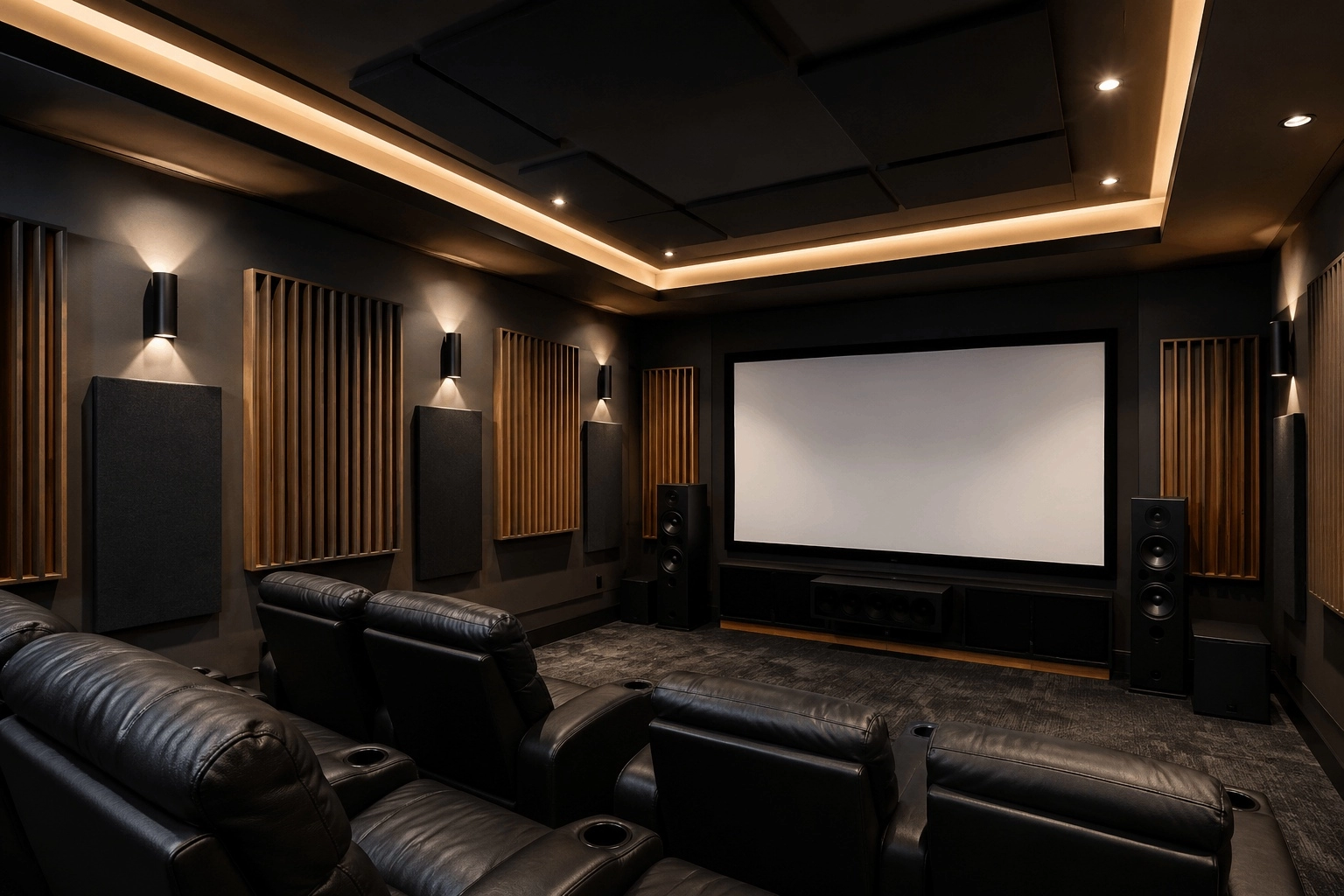
Modern acoustic panels are available in a wide range of colors, shapes, and patterns, allowing them to become part of the interior design.
Popular options include:
Black acoustic panels
Dark gray acoustic panels
Custom-color PET panels
Geometric acoustic panels
Decorative wall panels
Wood-look acoustic products
Custom-shaped acoustic panels
Dark acoustic panels can complement a traditional cinema atmosphere, while colorful or geometric designs may work better in a modern media room.
For multipurpose rooms, decorative acoustic panels can provide sound absorption without making the room look like a professional recording studio.
11. Consider Custom Home Theater Acoustic Panels
Standard-size products are suitable for many applications, but custom acoustic panels can be valuable when the room has unusual dimensions or specific design requirements.
Manufacturers may offer customization for:
Panel length
Panel width
Thickness
Color
Shape
Surface pattern
Mounting configuration
Custom panels can also be designed around:
Doors
Windows
Speakers
Lighting
Wall features
Decorative elements
For example, geometric PET acoustic panels can be arranged to create a specific visual pattern while providing sound absorption.
This makes customization particularly useful for high-end residential cinema projects and interior design-focused installations.
12. Check Fire Safety and Certifications
Fire safety should never be overlooked when selecting interior acoustic materials.
Depending on the location and building regulations, acoustic panels may need to meet specific fire performance requirements.
Before purchasing, ask the supplier for relevant documentation, such as:
Requirements can vary by country and project type.
A product that meets the requirements of one market may not automatically meet those of another. Buyers should therefore confirm applicable standards before placing a large order.
A professional acoustic panel manufacturer should be able to provide the necessary technical information.
13. Evaluate Installation Methods
The installation method can affect both acoustic performance and the final appearance.
Several approaches are commonly used.
Direct Wall Mounting
Panels can be mounted directly to walls using suitable adhesives, clips, or mechanical fasteners.
Framed Installation
Fabric-wrapped panels may use a frame system to create a clean, finished appearance.
Suspended Installation
Ceiling panels and acoustic clouds can be suspended from the ceiling to control overhead reflections.
Integrated Wall Systems
Multiple panels can be combined into a larger acoustic wall treatment.
Before ordering, confirm whether mounting hardware is included and whether the product can be installed without specialized equipment.
For complex installations, professional installation can help ensure correct placement and secure mounting.
14. Consider Durability and Maintenance
Home theaters generally experience less traffic than offices or commercial buildings, but acoustic panels should still be durable enough for long-term use.
When comparing products, consider:
PET acoustic panels can be attractive for this type of application because polyester fiber provides a combination of rigidity and lightweight construction.
However, actual durability depends on the panel's manufacturing process and material quality.
Request product specifications or samples when evaluating suppliers.
15. Compare the Total Project Cost
Price per panel is only one part of the overall cost.
A complete home theater acoustic treatment budget may include:
A low-cost panel may appear attractive initially but may not offer the acoustic performance or durability needed for the project.
Conversely, a more expensive panel may provide better long-term value through higher performance, easier installation, better appearance, and longer service life.
For this reason, buyers should compare the total installed cost rather than focusing only on the unit price.
16. Choose a Reliable Acoustic Panel Supplier
The quality of the supplier can directly affect the success of a home theater project.
When comparing acoustic panel manufacturers, consider several factors.
Product Range
Does the manufacturer offer different panel materials, thicknesses, sizes, and configurations?
Customization
Can the supplier produce custom colors, shapes, and dimensions?
Quality Control
Does the manufacturer have established quality inspection procedures?
Technical Support
Can the supplier provide acoustic data, installation recommendations, material specifications, and test reports?
Production Capacity
Can the manufacturer handle the required quantity if you are purchasing panels for multiple rooms or a large residential development?
Samples
Can you request samples before placing a large order?
A reliable supplier should be willing to provide detailed product information instead of focusing only on price.
Common Mistakes When Buying Home Theater Acoustic Panels
Choosing Panels Only for Appearance
An attractive acoustic panel is not necessarily an effective absorber.
Always check acoustic specifications before making a purchasing decision.
Covering Every Wall Without a Plan
More panels do not automatically mean better sound. Placement and room balance matter.
Confusing Acoustic Treatment with Soundproofing
Acoustic panels primarily control reflections within a room. They do not replace structural soundproofing.
Ignoring Low-Frequency Problems
Standard wall panels may not solve bass-related problems. Low frequencies may require dedicated bass traps or other treatment.
Buying Without Samples
Photos cannot always accurately represent material texture and color. Samples are particularly useful when appearance is important.
Choosing the Cheapest Product
A low initial price does not necessarily mean lower total cost. Consider performance, durability, installation, and service life.
Conclusion
Choosing the right home theater acoustic panels requires more than selecting an attractive product from a catalog. The best solution should be based on the room's dimensions, construction, speaker configuration, listening position, existing acoustic materials, and overall design.
Start by identifying the major reflection points and determining how much sound absorption the room actually needs. Then compare panel materials, thickness, acoustic performance, installation methods, fire safety, durability, customization options, and total cost.
PET acoustic panels, fabric-wrapped panels, and other acoustic materials can all be effective when properly selected and installed. For modern home theaters, PET panels are particularly attractive when buyers want a combination of sound absorption, lightweight construction, design flexibility, and potentially recycled materials.
Most importantly, remember that effective acoustic treatment is about balance. The goal is not to eliminate every reflection but to control unwanted sound, improve clarity, and create a comfortable listening environment.
For homeowners, interior designers, contractors, and acoustic product buyers, taking a systematic approach to selecting home theater acoustic panels can lead to better sound quality and better long-term value.
A properly planned acoustic environment allows the audio system to perform more effectively, making dialogue clearer, music more controlled, and movie sound effects more immersive. In the end, the right acoustic panels are not simply an accessory for a home theater—they are an important part of creating a room where the entire audio system can perform at its best.




 +86 18963687089

 en
en it
it es
es hu
hu ja
ja sv
sv pt
pt ms
ms ko
ko ru
ru fr
fr de
de ar
ar