Designing a high-quality home theater involves much more than choosing the right projector, speakers, and comfortable seating. The acoustic characteristics of the room have a direct impact on how clearly and naturally sound is experienced. Hard walls, ceilings, floors, windows, and other reflective surfaces can cause sound waves to bounce around the room, creating echoes, excessive reverberation, and reduced dialogue clarity.
This is where acoustic treatment becomes important. Home theater acoustic panels are designed to absorb unwanted sound reflections and create a more controlled listening environment. However, one question frequently comes up when selecting acoustic treatment: How thick should home theater acoustic panels be?
The answer is not simply "the thicker, the better." Panel thickness affects the frequencies a material can absorb, but other factors—including material density, panel construction, air gaps, room dimensions, and placement—also influence acoustic performance.
For homeowners, interior designers, contractors, and acoustic product buyers, understanding these factors makes it easier to choose the right acoustic panels for home theater rooms without spending unnecessarily on unsuitable products.
Why Does Acoustic Panel Thickness Matter?
Sound consists of different frequencies, and each frequency behaves differently inside a room.
High-frequency sounds have shorter wavelengths and are generally easier for porous materials to absorb. Lower-frequency sounds have longer wavelengths and typically require thicker absorbers or specialized acoustic treatment.
This means a relatively thin acoustic panel may work well for controlling some high-frequency reflections, while a thicker panel can provide broader sound absorption.
For example, a room with excessive high-frequency reflections may benefit from strategically positioned wall panels, while a theater suffering from strong low-frequency problems may require thicker absorbers, bass traps, or other specialized solutions.
Therefore, when evaluating acoustic panel thickness for home theaters, buyers should consider the entire frequency range rather than focusing on thickness alone.
What Is a Good Thickness for Home Theater Acoustic Panels?
There is no single thickness that works perfectly for every home theater. However, acoustic panels commonly used for residential applications are available in several thickness ranges, with each providing different levels of sound absorption.
Thin Acoustic Panels
Panels around 10–20 mm thick are often selected for decorative purposes or for controlling some higher-frequency reflections.
They can be useful where wall space is limited or where the primary goal is to combine acoustic treatment with decorative design.
However, very thin panels generally have limited effectiveness at lower frequencies. They should not be expected to solve significant bass or broadband acoustic problems by themselves.
Medium-Thickness Acoustic Panels
Panels around 20–40 mm thick can provide more useful broadband absorption than very thin decorative products.
This range may be suitable for general-purpose wall treatment in smaller media rooms, especially when the room already contains carpets, upholstered furniture, curtains, or other absorptive materials.
Thicker Acoustic Panels
Panels around 40–60 mm or thicker can provide stronger broadband absorption and are often considered for more demanding home theater applications.
Thicker panels are particularly useful when the goal is to control a wider range of frequencies rather than simply reducing high-frequency reflections.
However, the actual performance depends heavily on the material and construction. A 50 mm panel made from one material cannot automatically be assumed to perform exactly like a 50 mm panel made from another material.
For this reason, buyers should examine acoustic test data whenever possible.
Is Thicker Always Better?
Not necessarily.
One of the most common misconceptions about home theater acoustic panels is that increasing thickness automatically produces proportionally better acoustic performance.
Thickness is important, but it is only one part of the equation.
Other factors include:
A poorly designed thick panel may not perform as well as a properly engineered panel with a different construction.
In addition, using extremely thick absorbers everywhere can result in excessive high- and mid-frequency absorption. This may make the room sound unnaturally "dead."
A well-designed home theater usually needs balance rather than maximum absorption.
How Does Material Density Affect Acoustic Performance?
Thickness and density should be considered together.
Acoustic panels made from porous materials absorb sound by converting some of the sound energy into small amounts of heat as sound waves move through the material.
The internal structure of the material determines how sound interacts with it.
For example, polyester fiber acoustic panels have a fibrous structure that allows sound waves to penetrate into the panel. The fibers then help dissipate acoustic energy.
However, extremely high density does not automatically guarantee better performance across all frequencies.
The ideal density depends on the material, thickness, manufacturing process, and intended application.
When comparing high-density acoustic panels for home theaters, buyers should therefore review the manufacturer's test results instead of judging quality based solely on density.
Why Air Gaps Can Make Acoustic Panels More Effective
Another factor that is often overlooked is the space between an acoustic panel and the wall.
Installing a porous acoustic panel directly against a wall is not always the most acoustically efficient configuration.
Creating an air gap behind the panel allows sound waves to interact with a larger effective depth of the acoustic treatment. This can improve absorption performance, particularly at lower frequencies.
For example, a relatively moderate-thickness panel installed with an appropriate air gap may perform differently from the same panel mounted directly against a hard wall.
This gives designers another way to improve acoustic performance without necessarily selecting an extremely thick product.
For homeowners with limited wall space, the installation configuration can therefore be just as important as the panel thickness itself.
What Thickness Is Best for Wall-Mounted Acoustic Panels?
Wall-mounted acoustic panels are one of the most common solutions for home theaters.
For general wall treatment, medium-to-thick panels can provide a good balance between acoustic performance and appearance.
The appropriate thickness depends on the purpose of the wall treatment.
If the objective is primarily to reduce high-frequency reflections, thinner panels may be sufficient.
If the objective is broader sound absorption, thicker panels are generally more appropriate.
For first reflection points, the panel does not necessarily need to be extremely thick if the room has already been acoustically balanced through carpets, curtains, furniture, and other treatments.
The best approach is to consider the wall treatment as part of the entire room rather than evaluating individual panels in isolation.
How Thick Should Ceiling Acoustic Panels Be?
Ceiling treatment is particularly useful in home theaters with hard ceilings.
Sound from front, center, and surround speakers can reflect from the ceiling before reaching the listener. These reflections can affect speech clarity and imaging.
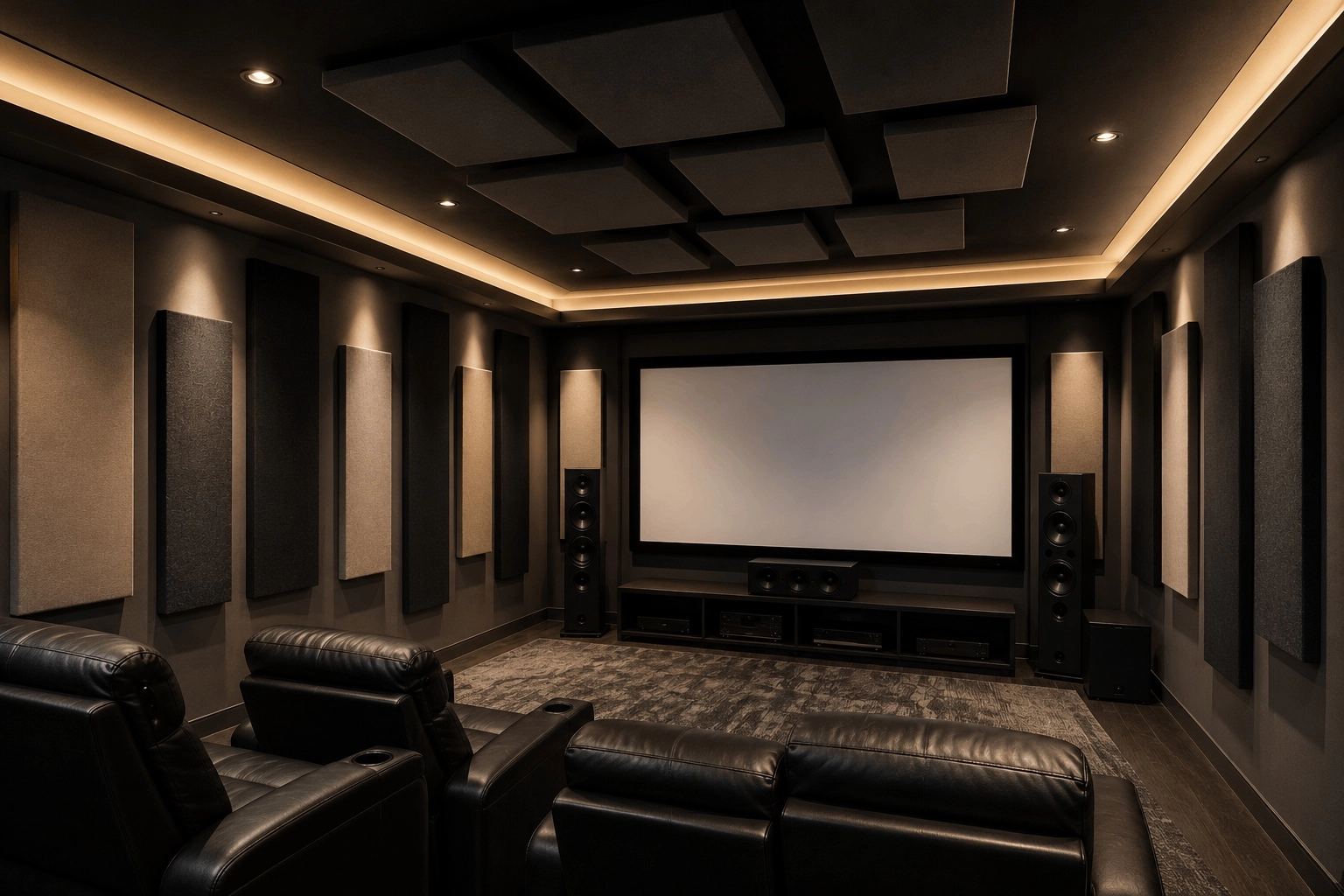
Suspended or ceiling-mounted acoustic panels for home theater rooms can help control these reflections.
A moderate or thicker panel can be useful for broadband absorption, especially when the ceiling is relatively high or highly reflective.
Suspended installation can also create an air gap between the panel and ceiling, potentially improving its effectiveness.
However, ceiling treatment must be securely installed. Buyers should select mounting systems designed for the panel's weight and the specific ceiling structure.
Should You Use Thick Panels on the Rear Wall?
The rear wall deserves special attention because its acoustic requirements can differ from those of the side walls.
If seating is positioned close to the rear wall, sound reflections may become particularly noticeable.
Thicker absorption can help control these reflections, but the correct solution depends on the overall acoustic design.
Some home theaters benefit from a combination of absorption and diffusion on the rear wall rather than covering it completely with thick absorbers.
This approach can help maintain a sense of acoustic spaciousness while controlling strong reflections.
For larger dedicated theaters, a combination of home theater acoustic treatment methods may therefore be more effective than relying exclusively on thick wall panels.
What About Low-Frequency Sound?
Low-frequency sound is one of the biggest challenges in home theater design.
Subwoofers generate powerful bass energy that can interact with room boundaries and create standing waves. This can produce areas where bass sounds excessively strong and other areas where it seems weak.
Standard wall-mounted acoustic panels, even relatively thick ones, may not fully resolve serious low-frequency problems.
Low-frequency treatment may require:
This is why buying very thick wall panels simply because you want better bass control may not produce the expected result.
For serious home theater projects, bass management should be considered separately from standard mid- and high-frequency absorption.
PET Acoustic Panels: Are They Suitable for Home Theaters?
PET acoustic panels have become increasingly popular for residential and commercial acoustic applications.
They are typically manufactured from polyester fiber, with many products using recycled PET content.
One reason they are attractive for home theaters is their combination of:
Lightweight construction
Sound absorption
Design flexibility
Durability
Easy processing
Wide color selection
PET acoustic panels can be manufactured in different thicknesses and shapes, allowing them to be used for wall panels, ceiling panels, acoustic baffles, and decorative treatments.
For buyers looking for PET acoustic panels for home theaters, thickness should still be selected according to the room's acoustic requirements rather than simply choosing the thickest available option.
The supplier should ideally provide acoustic test results showing how the product performs across different frequencies.
How Room Size Affects Acoustic Panel Thickness
Room dimensions play an important role in acoustic treatment.
A small home theater can develop strong reflections because sound waves travel between walls over relatively short distances.
A larger room may have longer reverberation times and greater overall sound energy within the space.
Room shape also matters.
A rectangular room may have different acoustic problems from an irregularly shaped room. Parallel walls can create repeated reflections, while certain room dimensions may reinforce specific frequencies.
For this reason, acoustic panels for small home theaters do not necessarily need the same thickness or quantity as panels used in large dedicated cinema rooms.
The larger the project, the more valuable a room-specific acoustic assessment becomes.
How Much Acoustic Panel Coverage Do You Need?
Thickness is only one part of the acoustic equation. The total amount of treated surface area also matters.
For example, installing a few extremely thick panels may not provide the same overall result as strategically distributing moderately thick panels across several reflection points.
When planning acoustic treatment, consider:
A balanced design often combines different panel thicknesses and treatment types.
This allows the room to control reflections without becoming excessively absorptive.
Where Should Acoustic Panels Be Installed?
Correct placement can significantly improve the effectiveness of acoustic treatment.
Side Walls
Side walls are common locations for controlling first reflections from the main speakers.
Rear Wall
The rear wall can require absorption or diffusion depending on the seating distance and room design.
Ceiling
Ceiling panels can help reduce vertical reflections.
Front Wall
The wall behind the screen and front speakers may require specialized acoustic treatment depending on the speaker system and room construction.
Corners
Corners are often important locations for low-frequency treatment rather than standard flat acoustic panels.
Strategic placement is usually more effective than simply covering as much wall area as possible.
How to Choose Acoustic Panel Thickness Based on Your Goal
Different acoustic goals call for different approaches.
For Echo Reduction
If the main problem is noticeable echo in a relatively reflective room, medium-thickness acoustic panels distributed across major reflection surfaces may provide a significant improvement.
For Better Dialogue Clarity
Focus on first reflection points and areas surrounding the listening position. Appropriate wall and ceiling treatment can reduce reflections that interfere with speech.
For Better Music Reproduction
A balanced acoustic strategy is important. Excessive absorption can affect the natural character of the room, so absorption and diffusion may need to be combined.
For Bass Problems
Do not rely solely on standard wall panels. Consider dedicated bass traps or specialized low-frequency absorbers.
For Decorative Acoustic Treatment
Thinner PET or fabric acoustic panels may provide a practical balance between visual appearance and basic sound absorption, depending on the room.
Common Mistakes When Choosing Acoustic Panel Thickness
Choosing the Thickest Panel Available
More thickness does not automatically solve every acoustic problem.
Ignoring Air Gaps
The installation distance from the wall can influence acoustic performance.
Treating Every Wall the Same Way
Different surfaces have different acoustic roles. First reflection points, rear walls, ceilings, and corners may require different treatments.
Expecting Wall Panels to Fix Bass
Low-frequency problems often require specialized acoustic solutions.
Focusing Only on NRC
NRC is useful, but frequency-specific absorption data can provide a more complete picture.
Installing Too Much Absorption
A room covered with absorption everywhere may sound overly dry or unnatural.
Buying Without Samples or Test Data
For larger projects, request samples and technical information before placing a substantial order.
How to Evaluate an Acoustic Panel Supplier
For homeowners and contractors purchasing several panels, supplier quality is an important consideration.
Look for manufacturers that can provide:
Product specifications
Acoustic test reports
Material information
Fire performance documentation
Custom sizes
Multiple thickness options
Color choices
Installation recommendations
Samples
A capable manufacturer should be able to explain how different panel thicknesses perform rather than simply recommending the most expensive product.
For larger residential developments, hotel projects, or custom cinema installations, production capacity and quality consistency are also important.
A Practical Guide to Choosing Panel Thickness
Instead of asking, "What is the best thickness?" ask a series of more useful questions:
What frequencies need to be controlled?
If the problem is primarily high-frequency reflection, very thick panels may not be necessary.
How reflective is the room?
A room with hard flooring, bare walls, and a hard ceiling will usually require more acoustic treatment than a room with carpet, curtains, and upholstered furniture.
Where will the panels be installed?
Wall, ceiling, rear-wall, and corner applications may require different solutions.
Is there an air gap?
A properly designed air gap can improve the performance of an absorber.
Is the goal sound absorption or soundproofing?
These are different objectives and require different solutions.
Are there serious bass problems?
If so, dedicated low-frequency treatment may be necessary.
Answering these questions will usually provide a better basis for selecting panel thickness than relying on a single standard measurement.
What Should Buyers Ask Before Ordering?
Before purchasing home theater acoustic panels, ask the supplier for specific information.
Useful questions include:
What thickness options are available?
What material is used?
What is the material density?
Is acoustic test data available?
What are the absorption coefficients at different frequencies?
Can the panel be installed with an air gap?
Are custom sizes available?
Are different colors and surface finishes available?
Does the product have relevant fire performance documentation?
Can the manufacturer provide samples?
These questions help buyers compare products based on measurable performance rather than marketing descriptions alone.
Conclusion
So, how thick should home theater acoustic panels be for effective sound absorption?
There is no universal thickness that works for every room. In general, thinner panels can be useful for controlling certain high-frequency reflections and providing decorative acoustic treatment, while medium and thicker panels offer broader sound absorption. However, thickness must always be considered together with material density, air gaps, room dimensions, panel placement, and the frequencies that need to be controlled.
For many home theater projects, a combination of strategically positioned wall and ceiling panels provides better results than simply choosing the thickest possible product. First reflection points should receive careful attention, while low-frequency problems may require dedicated bass traps or other specialized solutions.
PET acoustic panels can be a practical choice for modern home theaters because they combine sound absorption with lightweight construction, design flexibility, and a wide range of customization possibilities. Whether you choose PET, fabric-wrapped, or another acoustic material, the most important factor is matching the product to the actual acoustic requirements of the room.
Ultimately, effective home theater acoustic treatment is about balance. The right combination of panel thickness, coverage, placement, material, and installation can reduce unwanted reflections while preserving a natural and immersive listening experience. Instead of asking which panel is simply the thickest, buyers should ask which acoustic solution provides the right performance for their specific room.
That approach can lead to clearer dialogue, better sound imaging, more controlled music and movie effects, and a more enjoyable home theater experience.




 +86 18963687089

 en
en it
it es
es hu
hu ja
ja sv
sv pt
pt ms
ms ko
ko ru
ru fr
fr de
de ar
ar